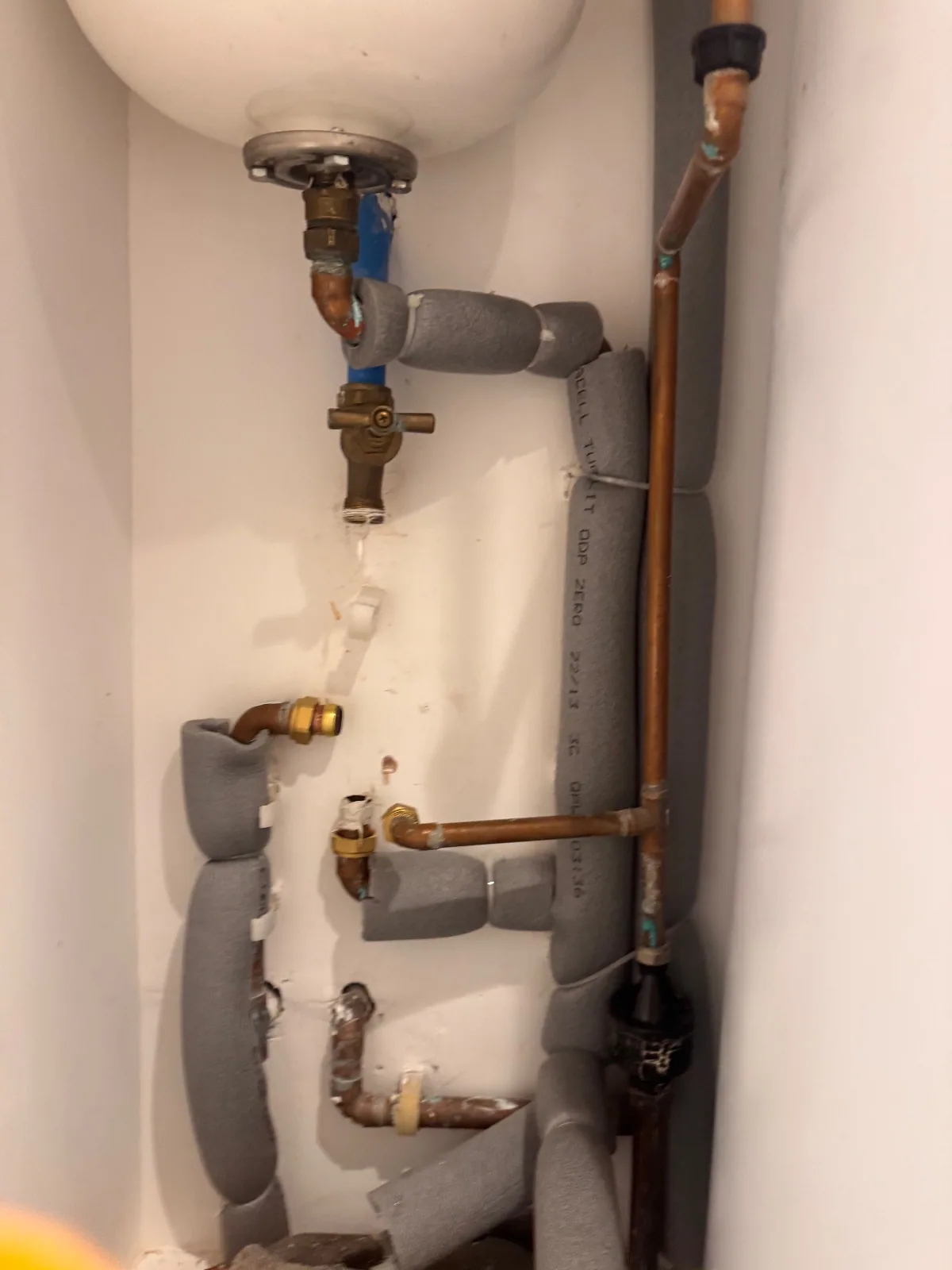
Design for the way residents actually use hot water
A shared property can have concentrated demand when several people shower before work or return home together. We ask about the number of occupants, bathrooms, baths and showers, but also the timing and duration of use. A fixed litres-per-bedroom rule does not capture the difference between staggered use and a busy period with overlapping outlets.
Tell us whether the system has always struggled or has deteriorated recently. A recent loss of capacity can be caused by a failed heating component or control. We distinguish that repair from a system that no longer suits occupancy, so the proposal addresses the real problem rather than automatically increasing the cylinder size.
Investigate breakdowns and unreliable hot water
We assess no-hot-water complaints, poor recovery, immersion faults, control failures and cylinder leakage. The investigation identifies which residents or outlets are affected and whether the heat source, storage or distribution is involved. One shower failing while other taps remain hot calls for a different repair from all outlets running cold.
For urgent loss of service, identify the site contact and residents who are particularly affected. We establish what can safely be repaired and what depends on parts, access or a wider installation change. Any interim arrangement must be suitable for the actual system; an existing immersion should not be assumed safe or adequate as a universal backup.
Specify capacity, recovery and supply together
For an upgrade, we review storage volume alongside the heat source’s ability to restore hot water between uses. We also assess the incoming supply and distribution under relevant demand. A larger vessel does not guarantee several showers can run at full performance if the water supply or pipe routes are restrictive.
The installation proposal explains the expected use pattern and its limitations. Where occupancy or bathroom provision is changing, provide that future brief before equipment is selected. Multiple units or a different system arrangement can require a wider design and controls scope; we do not treat a shared property as a standard domestic replacement simply because one cylinder is currently fitted.
Keep controls usable and access accountable
Residents need a practical way to obtain the intended hot-water service, while the manager needs appropriate control of maintenance access and settings. We discuss schedules, ordinary user controls and who can authorise changes. Repeated unexplained changes by several occupants can make fault investigation harder, so a clear operating arrangement is useful.
Service spaces should remain accessible to the responsible person without inviting occupants to alter electrical connections or safety devices. Where control accounts or timers are replaced, record who manages them and how tenants report a fault. The installation handover needs to work for the people running the building, not only the owner who approved the quotation.
Coordinate plumbing with landlord responsibilities
HMO licensing and property requirements depend on the local authority and the particular premises. GOV.UK directs owners to the relevant council for licensing, and local schemes can cover properties beyond the mandatory national category. We need any applicable specification or licence condition that affects the proposed hot-water work before the design is final.
HSE also explains landlords’ responsibility to assess and control legionella risks proportionately. Cylinder installation or a plumbing repair does not by itself complete every water-hygiene, housing or licensing duty. We define our work and records clearly and coordinate with the property’s responsible person where a wider assessment or management arrangement is required.
Plan work around an occupied shared building
We agree the affected services, access contacts, working area and shutdown sequence before installation. Residents need notice and a reliable reporting contact, while locked cupboards and shared isolation points need the correct keyholder. The work plan should identify whether particular facilities can remain available and what happens if an unforeseen defect delays restoration.
Unvented installation and safety work require appropriate competence, with any electrical or gas work matched to the equipment. We specify suitable safety and discharge arrangements and retain service access. If there is dangerous overheating or hot, steaming discharge, report it urgently; occupants must not adjust safety valves, open covers or repeatedly reset hidden cut-outs.
Price the work around occupancy and access
The proposal distinguishes investigation, the selected plant or component work, distribution changes and commissioning. Occupied-room access, shared shutdowns and phased work can affect delivery, so the programme forms part of the scope. We also identify any separate water-hygiene assessment or building work that the manager must coordinate, with additional findings returned for approval rather than treated as an open-ended instruction.
Handover and planned maintenance for the property
At completion, we explain the controls, checks and remaining limitations, and identify the documentation relevant to the installed equipment. Keep an asset record with model details, service requirements and the location of normal isolation controls. A named maintenance contact and a clear fault history make future visits more useful than scattered messages from several residents.
To arrange an HMO hot-water assessment, send the address, occupancy, bathroom arrangement, current heat source and whether the job is a breakdown or planned upgrade. Mention any council requirement and proposed building work. Loyal Plumbers can request supporting plans or records by email after enquiry and develop the repair or installation scope for the property.
Common questions
What cylinder size does an HMO need?
There is no universal size based only on bedroom count. We assess peak use, usable storage, recovery and supply conditions, with the property’s applicable requirements. The design should state the demand it is intended to serve.
Will a new cylinder make the property HMO compliant?
It addresses the agreed hot-water installation scope. Licensing, housing standards and other safety responsibilities extend beyond a single plumbing job. Check the council requirements and coordinate the relevant assessments separately.
Can maintenance be arranged after installation?
Yes, the equipment and property arrangements can form an agreed maintenance scope. Tasks, access, records and repair authorisation should be defined, including any separate water-hygiene or statutory inspection duties.
Sources and further reading
Need help with this in London?
Emergency repairs, investigations and planned installations across London and inside the M25. Tell us what you need so we can agree the next step.
Discuss your job