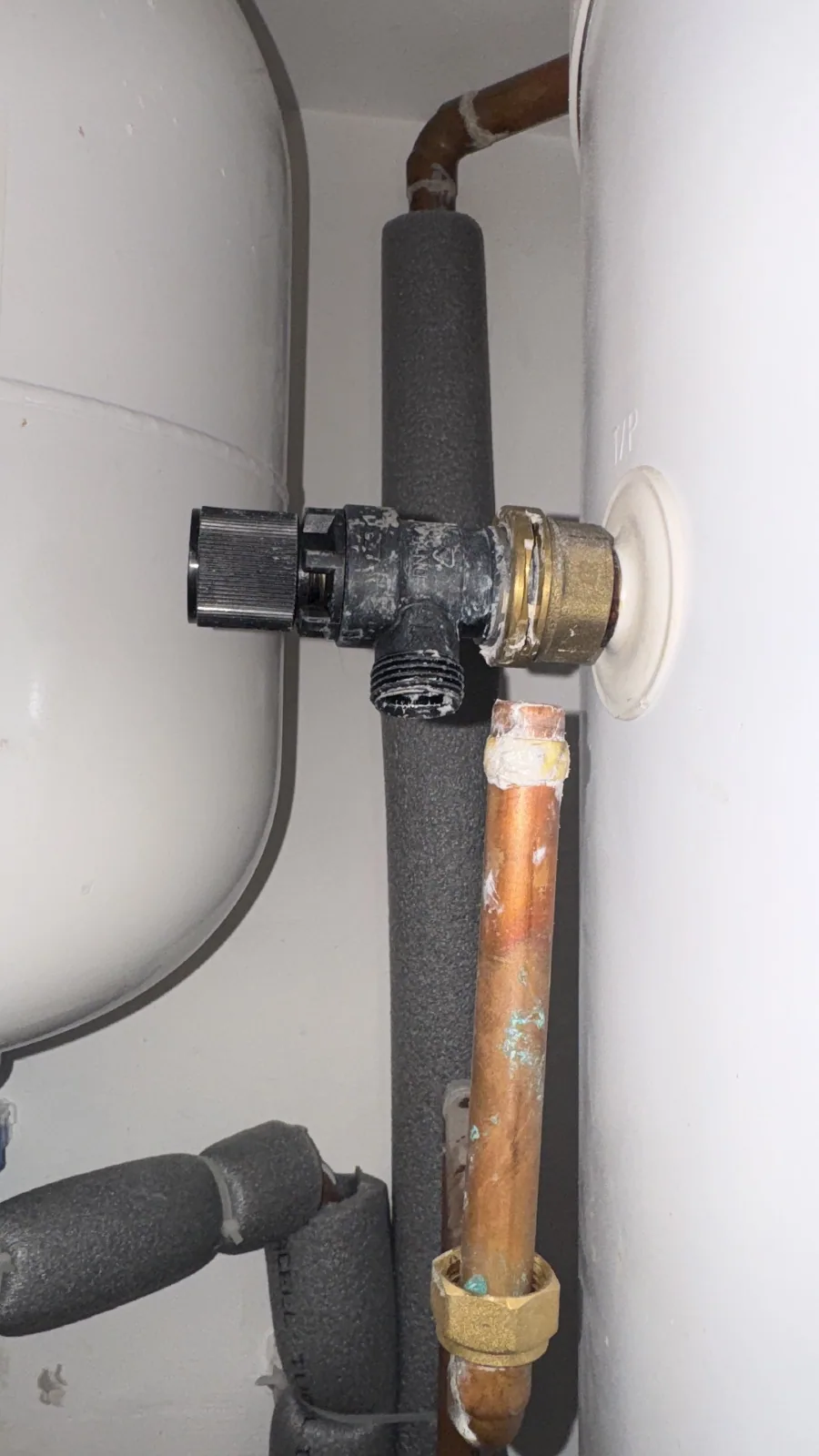
Investigate discharge before selecting a valve
Unvented cylinders rely on a coordinated set of controls and protective devices. Discharge can be associated with expansion, incoming pressure, temperature control or a defective component. We establish when it occurs, which route is involved and how the system behaves before recommending replacement.
Describe whether discharge is occasional or continuous, whether it changes during heating and whether water is unusually hot. Keep clear of hot outlets and do not touch the stream to test its temperature. A visible drip is useful evidence, but the assessment needs the complete arrangement rather than a customer being asked to operate valves and report what happens.
Identify the protective component correctly
A temperature-and-pressure relief valve, an expansion-relief component and an inlet pressure-control assembly have different functions. They must not be treated as interchangeable taps. We identify the cylinder model and the exact part, including the manufacturer requirements relevant to its rating, connections and installation.
A valve that physically screws into place can still be unsuitable. Replacement selection needs the intended protective function and the complete system design. We use the model information and appropriate component specification rather than copy an unidentified part that may have been fitted incorrectly during earlier work.
Check the cause and connected controls
If a valve is releasing water because the system is reaching an abnormal condition, replacing it alone can leave the underlying fault untouched. We assess relevant expansion provision, inlet controls and heating or temperature-control behaviour. Any related repair is explained and agreed as part of restoring the safety arrangement.
Some cylinders use an external expansion vessel while others use a model-specific internal arrangement. That distinction affects diagnosis. We do not assume that every tundish drip needs a new vessel or every discharge needs a new relief valve. The proposal follows the findings and identifies what further checks are needed if the cause remains uncertain.
Replace the valve using the correct safe procedure
Unvented-cylinder safety work requires appropriate competence and correct isolation, draining and reassembly procedures for the installation. We agree access and interruption to hot water before the work. Electrical or heat-source work is handled with the relevant competence where it forms part of the repair.
Do not prepare for the visit by draining the cylinder, loosening a valve or turning a test lever. Protective components and discharge routes must remain unblocked. A temporary cap or plug can remove a critical safety function. If leakage needs containment, report the location and risk so a safe response can be agreed without disabling the protection.
Inspect the discharge route as part of the job
The protective device must discharge through an arrangement suited to the installation requirements. We check the relevant accessible route and identify restrictions, unsuitable alterations or missing access that affect the repair. A newly fitted valve cannot compensate for a blocked or incorrectly arranged discharge path.
Changes to boxing, drains or nearby building work can affect access and routing. Tell us about any alterations since the cylinder was installed. Where additional pipework work is required, we explain its purpose and scope rather than leave the owner with a replaced component attached to a known unresolved defect.
Respond urgently to overheating or steam
If very hot water or steam is discharging, keep people away and stop the cylinder’s heat sources through normal accessible controls only if it is safe. Do not turn off the water supply as a generic response to overheating, and do not approach or manipulate the safety valve. Seek urgent professional assistance; immediate danger requires an emergency response.
Water becoming unexpectedly scalding at outlets also needs prompt attention. Stop using affected taps or showers and protect vulnerable occupants from exposure. Do not open electrical covers or reset concealed cut-outs to restore service. The repair enquiry should describe the overheating, not simply request a particular valve that has not been diagnosed.
Quote for the cause and the required repair
The repair scope depends on the exact valve, supported replacement, safe isolation and access to the discharge connections. We identify any pressure, expansion or control fault found alongside it, since changing the valve alone may not resolve discharge. Where additional work is needed, the proposal distinguishes the component replacement from correction of the connected installation and the checks required afterwards.
Check and record the completed repair
After the agreed work, we check the relevant safety and operating arrangement according to the equipment requirements. We explain the component replaced, any associated repairs and what remains outstanding. Where a cylinder service is also due, it can be scoped separately rather than assumed included in a single component-replacement job.
To contact Loyal Plumbers, provide the postcode, visible cylinder details and the discharge symptoms. Mention earlier repairs and any available service record; the team can arrange sharing by email after enquiry. We support homes and managed properties across London and inside the M25, with the repair scope based on the model and actual findings.
Common questions
Can I stop a dripping safety valve by tightening it?
Do not adjust or interfere with an unidentified protective component. Discharge can indicate a system fault that needs assessment. Never cap a safety outlet or block its discharge pipe to stop the water.
Does a replacement valve fix every tundish drip?
No. Expansion, inlet pressure and temperature-control problems can cause discharge. We investigate the cause and replace the valve when the findings support that repair.
Is this ordinary tap or plumbing-valve replacement?
No. A cylinder safety valve performs a protective function within an unvented system. The part, procedure and checks must suit the cylinder and be handled by someone competent for that work.
Sources and further reading
Need help with this in London?
Emergency repairs, investigations and planned installations across London and inside the M25. Tell us what you need so we can agree the next step.
Discuss your job